Views: 0 Author: Site Editor Publish Time: 2026-09-28 Origin: Site
Centrifuge tube material and construction directly affect centrifugation performance, chemical compatibility, sealing, and daily laboratory handling.
When comparing centrifuge tube materials, laboratories should consider the tube body, wall consistency, cap design, bottom structure, graduations, and application requirements together.
Material matters: Polypropylene is widely used for centrifuge tubes because of its durability and chemical resistance.
Construction affects performance: Wall consistency, cap fit, and bottom geometry influence centrifugation and handling.
Check RCF: Use the manufacturer's published centrifugal-force rating for the exact tube size and design.
Match the application: Sterility, contamination-control requirements, temperature range, and chemical exposure vary by workflow.
Validate before bulk purchasing: Review technical specifications and test representative samples whenever necessary.
Tube material influences mechanical strength, transparency, chemical resistance, and temperature performance.
For most routine laboratory centrifugation, polypropylene (PP) is a common choice because it combines good durability with resistance to many laboratory reagents.
Before selecting a material, check:
Required centrifugal force
Operating and storage temperature
Chemical exposure
Required optical clarity
Sterility and contamination-control requirements
Material | General Characteristics | Selection Consideration |
|---|---|---|
Polypropylene (PP) | Durable, lightweight, and resistant to many common chemicals | Common choice for routine centrifugation |
Polycarbonate (PC) | High transparency and good mechanical strength | Chemical compatibility should be checked carefully |
Polyethylene (PE) | Lightweight and chemically resistant in many routine applications | Centrifugation and temperature limits depend on the specific product |
Glass | High clarity and useful for selected chemical applications | Requires careful handling because of breakage risk |
Material names alone do not determine performance. Always use the specification for the exact tube being evaluated.
Gongdong offers centrifuge tubes in multiple capacities and configurations for routine laboratory workflows.
Consistent tube walls help distribute stress during centrifugation.
When comparing products, review:
Maximum published RCF
Tube size and geometry
Rotor and adapter compatibility
Operating temperature
Wall and bottom consistency
RCF is more useful than RPM for tube selection because it reflects the actual centrifugal force applied to the tube.
Cap design affects leakage resistance, handling, storage, and repeated opening and closing.
Check the complete closure system rather than evaluating the tube body alone.
Feature | What to Check |
|---|---|
Cap Fit | Secure closure without excessive force |
Threads | Smooth engagement without cross-threading |
Leak Resistance | Stable sealing during intended centrifugation and handling |
Temperature Compatibility | Tube and cap should both meet required temperature conditions |
Bottom geometry affects both centrifugation and laboratory handling.
Design | Main Advantage | Selection Consideration |
|---|---|---|
Conical Bottom | Helps concentrate pellets at the bottom | Usually requires a rack for upright handling |
Self-Standing Bottom | Can stand upright on the workbench | Check the published centrifugal-force limit for the exact design |
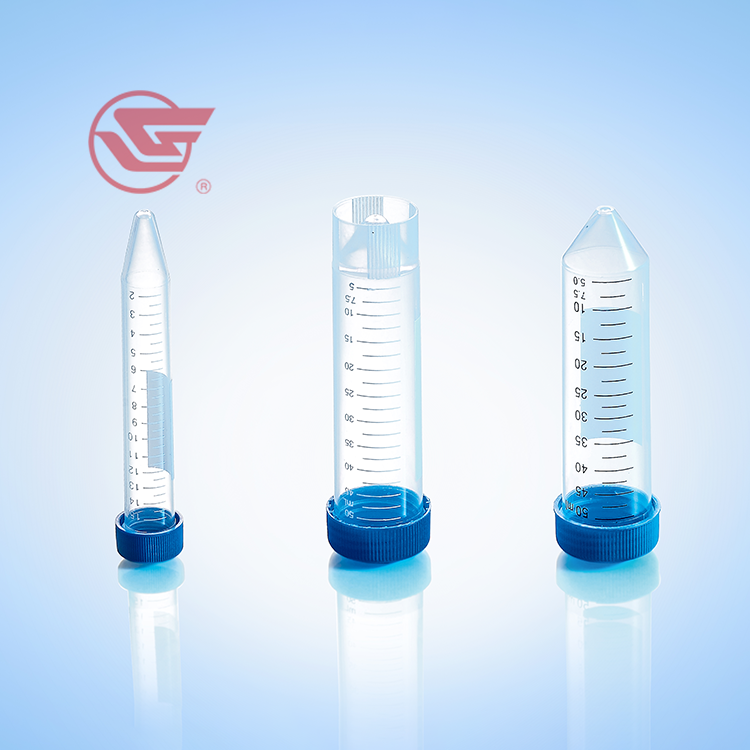
Clear markings improve routine sample preparation and identification.
Look for:
Easy-to-read graduations
Visible liquid levels
A practical writing or labeling area
Markings that remain readable during normal handling
Graduations on centrifuge tubes are generally used for convenient volume estimation rather than precision volumetric measurement.
15ml and 50ml tubes serve similar workflows but should not be treated as identical products.
Feature | 15ml Tube | 50ml Tube |
|---|---|---|
Typical Use | Small- to medium-volume sample processing | Higher-volume separation and handling |
Handling | Compact and easy to use with standard racks | Requires more rotor and storage space |
Selection Focus | RCF, dimensions, graduations, and cap sealing | RCF, bottom design, cap sealing, and rotor fit |
Always confirm dimensions and rotor compatibility before changing tube size or supplier.
Physical strength is only one part of centrifuge tube selection.
Sensitive laboratory workflows may also require specific cleanliness or biological specifications, such as:
Sterile packaging
RNase/DNase-free specifications
Low-binding properties
Pyrogen or endotoxin control
Other application-specific requirements
These characteristics should be confirmed using the supplier's technical documentation for the specific product.
Before bulk procurement, compare both the product and the manufacturer's supply capability.
Review specifications: Confirm material, size, RCF, temperature limits, and sterility.
Request samples: Test representative products with your centrifuges and routine workflows.
Check documentation: Review applicable quality and batch information.
Confirm packaging: Select packaging quantities and formats that fit laboratory usage.
Review supply capability: Consider production capacity, lead time, and continuity of supply.
You can also review Gongdong's centrifuge and cryo tube range for different tube sizes and laboratory applications.
Centrifuge tube performance depends on both material and construction. PP material, consistent walls, suitable bottom geometry, reliable cap sealing, and clear markings all contribute to practical laboratory use.
Before bulk purchasing, match the tube specification to the required RCF, temperature, chemical exposure, rotor, and application.
For centrifuge tube specifications, samples, packaging options, or laboratory consumable sourcing requirements, contact Zhejiang Gongdong® Medical Technology Co., Ltd.
A: Polypropylene combines good mechanical durability with resistance to many common laboratory chemicals.
A: RCF is the better reference for tube limits because it represents the actual centrifugal force applied to the tube.
A: Conical tubes help concentrate pellets, while self-standing tubes offer easier benchtop handling. Check the published RCF for each design.
A: Not necessarily. Tube and cap specifications may differ, so follow the manufacturer's published temperature and sterilization instructions.
A: Review material, tube size, RCF, cap sealing, bottom design, temperature range, sterility, packaging, and supplier documentation.