Views: 0 Author: Site Editor Publish Time: 2026-09-21 Origin: Site
A single needlestick injury can cost a hospital thousands of dollars in post-exposure medical testing, workers compensation claims, and lost operational productivity. This severe hazard impacts healthcare worker safety every single day across wards, clinics, and laboratories. Simply buying basic plastic bins is never enough in a high-stakes clinical environment where exposure to bloodborne pathogens carries life-altering consequences. Hospital administrators and procurement teams must learn how to qualify compliance effectively. We will explore the nuanced process of selecting proper disposal tools to ensure both frontline staff protection and strict adherence to federal legal frameworks.
Recent industry analyses highlight a definitive shift in medical waste management toward verifiable, cradle-to-grave compliance frameworks. Post-pandemic, federal agencies are ramping up workplace audits. They are moving away from merely checking for the presence of safety devices and are now demanding proof of structural integrity and proper disposal protocols. Concurrently, there is a growing engineering focus on balancing stringent infection control with eco-conscious manufacturing. High-density polypropylene construction is becoming the gold standard, offering maximum puncture resistance while maintaining environmental stability. Procuring certified disposal units is no longer just a purchasing checkbox. It represents a critical pillar of institutional risk management that demands rigorous supplier vetting.
Regulatory Alignment: A compliant disposal unit must meet stringent Occupational Safety and Health Administration OSHA Bloodborne Pathogens Standards and Food and Drug Administration FDA clearance requirements for puncture resistance and leak-proof engineering.
Proper Usage: Compliance extends far beyond the physical product itself. Hospital administrators must enforce the universal three-quarters full rule, strategic point-of-use placement, and strict segregation of infectious waste.
Smart Procurement: Choosing the right equipment requires evaluating departmental sizing needs, specialized safety locks like rotary caps or counter-balanced doors, and facility-specific workflow requirements.
Supply Chain Reliability: Partnering directly with a certified manufacturer is crucial to avoid critical supply shortages and ensure consistent, high-quality safety standards across all clinical departments.
In the fast-paced ecosystem of modern healthcare, medical waste management forms a fundamental pillar of occupational safety and infection control. Establishing a rigorous compliance framework is essential for shielding the facility from severe liabilities while protecting the nurses and physicians who save lives.
According to data published by the National Center for Biotechnology Information NCBI and the Centers for Disease Control and Prevention CDC, hundreds of thousands of percutaneous injuries occur annually in United States healthcare settings. Strikingly, a significant percentage of these injuries happen downstream during the disposal process or the handling of waste by environmental services staff. Imagine a chaotic trauma bay where personnel are moving rapidly. A dropped or improperly discarded needle becomes an invisible landmine. A properly engineered Sharp Container acts as the primary and most critical line of defense. For example, a standard 1-Quart unit measuring 115x115x162mm built from rigid polypropylene drastically reduces the physical interface between the healthcare worker and the contaminated instrument through hands-free disposal mechanisms.
Beyond the paramount concern for human well-being, non-compliance carries devastating financial and reputational risks. OSHA enforces the Bloodborne Pathogens Standard with intense scrutiny. Inspectors actively hunt for sharps management violations during unannounced facility audits. Common infractions include overflowing receptacles, units lacking the proper biohazard symbol, and the dangerous use of uncertified makeshift bins. Fines for these violations can exceed tens of thousands of dollars per instance, especially if deemed willful. If an employee contracts an illness due to a negligent disposal system, the hospital faces massive civil lawsuits and a damaged reputation that can take years to rebuild.
Navigating the complex landscape of medical waste compliance requires a deep understanding of the specific federal guidelines dictating how these products are manufactured and utilized. Procurement teams cannot rely on visual inspection alone. They must verify regulatory alignment through documented certifications.
In the United States, sharps disposal units are classified as Class II medical devices. The FDA mandates that manufacturers submit a 510k premarket notification demonstrating the device is both safe and effective before it enters a clinical setting. To achieve this clearance, the unit must pass rigorous standardized testing. This includes strict puncture resistance thresholds tested under ASTM F2132 standards to ensure needles cannot pierce the plastic. Furthermore, procuring FDA-cleared Medical Sharp Containers guarantees the product survives drop-test durability evaluations without cracking or releasing contents. The sides and bottom must be completely leak-proof to contain residual hazardous fluids.
While the FDA regulates the manufacturing of the device, OSHA dictates its operational use within the workplace under 29 CFR 1910.1030. OSHA mandates are highly specific. A compliant unit must feature a lid that can be securely closed prior to transport to prevent spillage. It must be designed to remain stable and upright throughout its lifecycle. Facilities are strictly forbidden from allowing these units to overfill, meaning they must be replaced routinely. The unit must be color-coded and prominently display the universal biohazard symbol to ensure immediate hazard recognition by all staff and visitors.
Selecting the appropriate equipment is not a one-size-fits-all endeavor. Hospital procurement officers must meticulously match the specific features of the disposal unit to the unique workflows and spatial constraints of different clinical departments. An engineering approach to sizing prevents both workflow bottlenecks and unnecessary spatial clutter.
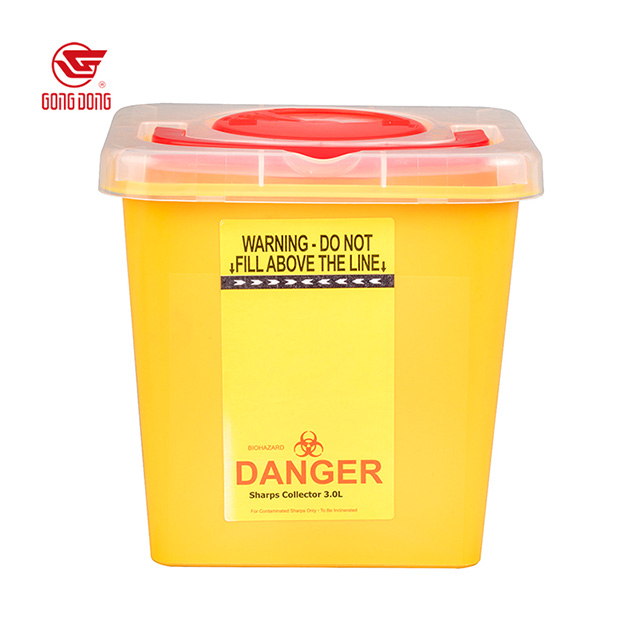
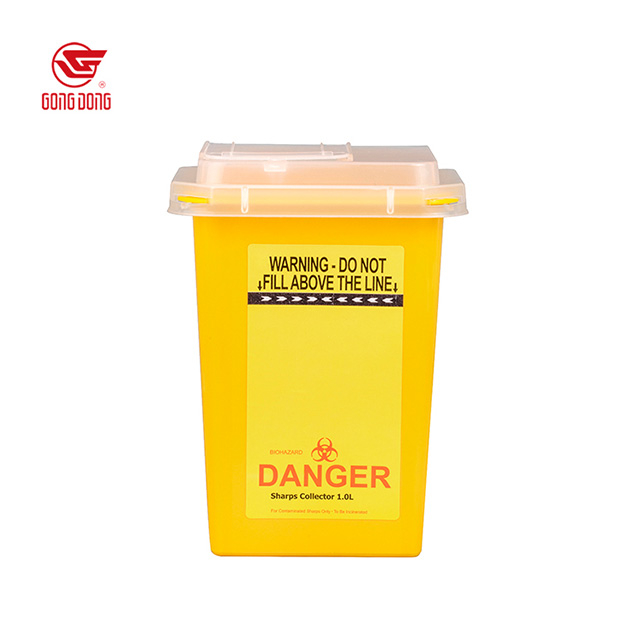
Using a unit that is too small in a high-volume area leads to rapid overfilling and immediate compliance hazards. Conversely, placing an excessively large bin in a low-volume triage station can lead to odor issues. For instance, 1-quart to 2-quart units are ideal for mobile medication carts and phlebotomy trays. Standard patient rooms typically require 1-gallon to 2-gallon capacities. For high-traffic emergency departments or operating rooms, a larger Sharps Disposal Container, such as a 3-Gallon model measuring 315x205x330mm, ensures adequate capacity for moderate to high turnover. Units ranging from 8-gallon to 13-gallon are reserved for centralized waste accumulation or surgical suites generating large trocars.
| Capacity / Type | Dimensions L x W x H | Ideal Clinical Application | Key Engineering Feature |
|---|---|---|---|
| 1 Quart Square | 115 x 115 x 162 mm | Phlebotomy trays, mobile carts | Compact footprint, tortuous path lid |
| 1 Gallon Square | 210 x 150 x 215 mm | Standard patient rooms, clinics | Counter-balanced drop door |
| 3 Gallon Square | 315 x 205 x 330 mm | Operating rooms, trauma bays | High volume capacity, permanent locking seal |
| Yellow Rotary Cap 1L-13L | Varies by volume | Chemotherapy, trace pharmaceutical waste | Rotary cap for secure, hands-free segregation |
The physical design of the lid and entry mechanism is arguably the most critical safety feature a procurement team must evaluate. Rotary caps and tortuous path designs allow instruments to be dropped in safely but physically prevent hands or fingers from entering the hazardous zone. Counter-balanced doors automatically flip closed after insertion, providing a hands-free, visually restrictive barrier. OSHA requires staff to monitor fill levels to prevent overfilling. Therefore, units must be constructed from polypropylene that is rigid and opaque enough to hide the graphic nature of the waste, yet translucent enough to easily identify when the internal contents have reached the maximum fill line.
Even the most highly engineered safety device becomes a compliance liability if hospital staff are not properly trained on what actually belongs inside it. Segregation of medical waste at the point of origin is an operational imperative. Mixing incompatible waste streams not only violates environmental regulations but also exponentially drives up incineration costs.
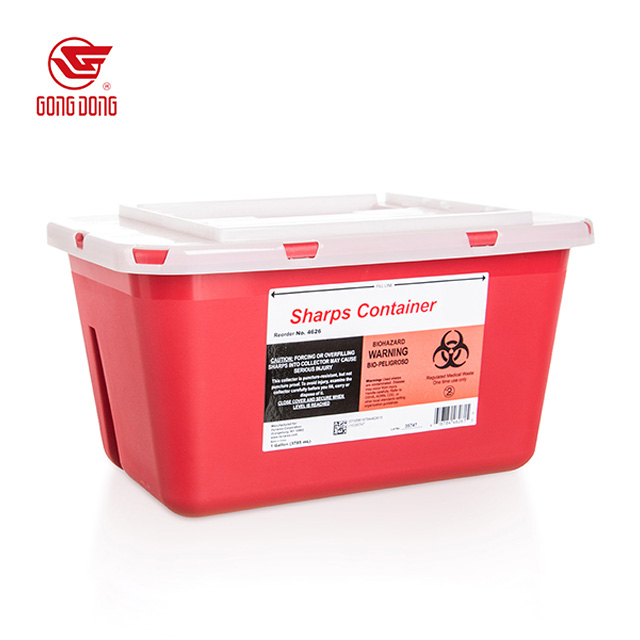
A Red Sharps Disposal Container is strictly reserved for items that can puncture, cut, or scrape the skin and are contaminated with blood or other potentially infectious materials OPIM. Acceptable items include hollow-bore hypodermic needles, syringes, suture needles, and surgical scalpels. Staff should also use these units for lancets, capillary tubes, auto-injectors like EpiPens, broken glass ampoules, and contaminated laboratory slides. A standard 1-Gallon unit measuring 210x150x215mm is perfectly calibrated for these daily clinical discards.
Staff frequently and mistakenly treat these specialized units as general biohazard bins, leading to rapid and unnecessary filling. Intact medication vials and blister packs do not belong here. Pharmaceutical waste requires specific, differently colored bins depending on RCRA regulations. Soft biohazardous waste, such as blood-soaked gauze, bandages, and gloves, should be placed in red biohazard bags. Placing soft waste in rigid bins wastes expensive capacity. Regular trash, paper towels, and medical device batteries must also be excluded to prevent incinerator fires and regulatory fines.
Procuring an FDA-cleared device is only the first phase of achieving full regulatory alignment. Compliance is a continuous, dynamic process that requires standardized operating procedures SOPs across all hospital departments. Administrators should implement the following structured, field-tested approach.
The physical location of a disposal unit significantly impacts its utilization rate. The National Institute for Occupational Safety and Health NIOSH emphasizes the point of origin principle, mandating that units be placed as close as feasible to where the instruments are used. This minimizes the dangerous distance a nurse must travel while holding an exposed needle. Wall-mounted brackets should position the opening at an ergonomic height, typically 52 to 56 inches from the floor for standing workstations, allowing staff to drop items safely without reaching blindly.
One of the most heavily cited OSHA violations is the overfilling of disposal units. Every compliant model features a clearly marked full line, universally set at the three-quarters capacity mark. Staff must be rigorously trained that three-quarters full means completely full. Waiting until needles are packed to the brim creates the dangerous porcupine effect, where needles protrude from the top, posing an immediate, catastrophic risk to the next user.
Waste reaching the designated fill line triggers an immediate protocol. The unit must be taken out of service immediately. Staff must engage the permanent locking mechanism on the lid, listening for the audible click that confirms secure closure. This seal must be absolute. Once locked, the unit should not be able to be reopened without extreme force. Temporary closures are acceptable during active shifts, but final disposal demands the permanent lock be fully engaged.
Once sealed, the units must be transported from patient care areas to the hospital central biohazard accumulation room. Staff handling these units must wear appropriate Personal Protective Equipment PPE and utilize dedicated utility carts with raised edges to prevent drops or spills during transit. Manually clutching multiple sealed units to the chest is a severe safety violation.
Hospital liability does not end when the unit reaches the loading dock. Facilities retain cradle-to-grave responsibility. It is imperative to partner strictly with licensed, audited medical waste haulers. These vendors transport the sealed units to off-site treatment facilities for autoclaving or complete incineration. Hospitals must meticulously maintain the destruction manifests provided by these vendors to prove compliance during state or federal environmental audits.
Global supply chain disruptions have starkly highlighted the vulnerability of hospital procurement networks. When a facility runs out of compliant disposal units, clinical operations are severely compromised. Elective surgeries may grind to a halt due to unacceptable safety risks. To build resilience, hospitals must carefully vet their supply chain partners based on engineering capabilities and production volume.
Procurement teams should establish direct relationships rather than relying solely on third-party distributors who frequently face allocation limits during crises. Partnering with a reliable Sharp Container manufacturer provides a vital buffer. During evaluation, verify that the manufacturer holds ISO 13485 certification, ensuring a comprehensive Quality Management System for medical devices. Confirm active FDA facility registrations and look for a diverse product catalog. A manufacturer capable of supplying everything from 1-quart phlebotomy bins to 13-liter yellow rotary cap units ensures the hospital can source all its needs from a single, stable pipeline.
In the event of an unavoidable, catastrophic supply chain collapse, the CDC and NIOSH have established emergency protocols. If standard FDA-cleared units are entirely unavailable, facilities may temporarily use alternative receptacles provided they meet strict baseline criteria. They must be heavy-duty plastic, closable, puncture-resistant, leak-proof, and properly labeled with biohazard warnings. However, utilizing household plastics introduces massive liability and physical risk. Securing a robust, direct-to-manufacturer supply contract is the most effective proactive strategy to prevent ever having to resort to these non-compliant crisis measures.
A disposal unit must be permanently closed and replaced when the internal waste reaches the designated fill line, which is universally set at three-quarters full. Overfilling past this point is a direct violation of OSHA regulations because it introduces the severe risk of needles protruding from the opening or bouncing back during insertion. Staff should never wait until the unit is completely full to the lid. Routine visual audits should be integrated into daily shift-change protocols to ensure timely replacement.
No. Standard household or commercial hard plastic containers do not meet the stringent regulatory requirements for medical environments. Compliant units must possess FDA 510k clearance, verifying they have passed standardized scientific tests for puncture resistance, leak-proof integrity, and drop-test durability. Using unverified plastics during normal operations violates OSHA standards and creates severe legal and physical liabilities for the healthcare facility.
The color-coding of disposal units dictates the specific type of hazardous waste they are legally permitted to hold. A red unit is the strict industry standard for general biohazardous sharps, such as needles and scalpels contaminated with blood or bodily fluids. Conversely, a yellow unit is typically designated for trace chemotherapy waste or specific pharmaceutical sharps, depending on state and local environmental regulations. Mixing these distinct waste streams can result in heavy compliance fines and improper treatment at the final disposal facility.
Deploying non-FDA cleared containers in a clinical setting exposes the hospital to immediate operational and legal dangers. Unverified plastics may shatter upon dropping or allow hypodermic needles to pierce through the sidewalls, directly leading to staff injuries. Furthermore, during an OSHA audit, the presence of uncertified equipment will result in heavy fines and potential facility citations for willful safety violations.
Once the container reaches the three-quarters fill line, engage the permanent locking mechanism on the lid until it clicks securely. Do not attempt to reopen it. Transport the sealed container using a utility cart to a designated, secure biohazard accumulation area. Final disposal must be handled by a licensed medical waste disposal contractor who will transport the units for proper autoclaving or incineration, providing a destruction manifest for your compliance records.
Hospitals should procure their inventory directly from a certified manufacturer or through authorized, highly vetted medical supply distributors. Sourcing directly from the manufacturer ensures product authenticity, guarantees immediate access to necessary compliance documentation like FDA clearances and ISO certificates, and provides stable, predictable pricing. Direct partnerships insulate the hospital from sudden supply chain shortages and allocation limits.
Maintaining a flawless compliance record and protecting frontline healthcare workers requires more than just standard procurement. It demands precision-engineered safety tools. For facility managers and procurement officers ready to upgrade their waste management framework, exploring a verified, manufacturer-direct catalog is the most strategic next step. You can find specialized, FDA-cleared solutions tailored to your exact departmental workflows, from 1-Quart phlebotomy units to heavy-duty surgical bins, at Gongdong's official site. Secure your supply chain and elevate your occupational safety protocols with proven medical-grade reliability.