Views: 0 Author: Site Editor Publish Time: 2026-09-21 Origin: Site
Choosing the right centrifuge tube helps protect sample integrity, equipment safety, and daily laboratory efficiency.
When comparing centrifuge tube specifications, focus on material, centrifugal-force rating, temperature resistance, tube design, sealing performance, and application requirements.
Check the material: PP centrifuge tubes are widely used because of their chemical resistance and durability.
Compare RCF, not RPM alone: Maximum centrifugal force should match the centrifuge and rotor used in your laboratory.
Review temperature limits: Storage, freezing, centrifugation, and heat treatment may require different tube specifications.
Check tube design: Conical or self-standing bottoms, graduations, caps, and sealing structure can affect workflow.
Verify supplier documentation: Product specifications, sterilization information, and batch consistency should be reviewed before bulk purchasing.
Material selection affects chemical resistance, clarity, durability, and centrifugation performance.
Polypropylene (PP) is commonly used for laboratory centrifuge tubes because it provides good resistance to many routine laboratory chemicals and mechanical stress.
Before purchasing, check:
Tube material and manufacturing consistency
Sterile or non-sterile configuration
Required contamination-control specifications
Clarity and graduation visibility
Batch and quality documentation
Do not assume that every sterile tube is suitable for every molecular biology, clinical, or research application. Match the specification to the actual workflow.
RCF describes the actual centrifugal force applied to the tube. RPM alone does not show the complete mechanical load because rotor radius also affects centrifugal force.
Before selecting a tube, confirm:
Maximum permitted RCF
Tube volume and fill condition
Fixed-angle or swinging-bucket rotor
Tube support inside the rotor or adapter
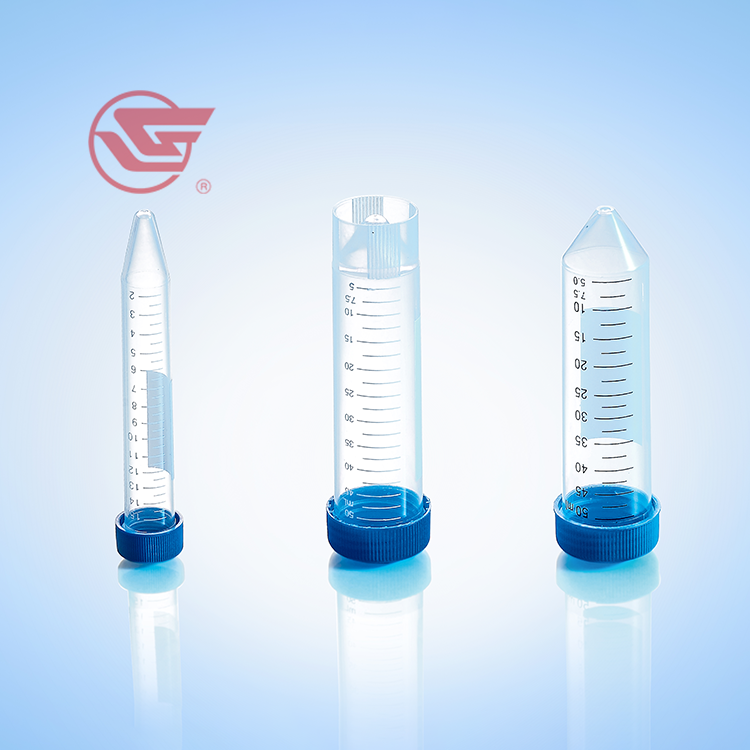
For example, Gongdong's 15ml and 50ml centrifuge tubes specify centrifugal-force limits according to tube size.
Specification | Published Maximum Force |
|---|---|
15ml Centrifuge Tube | Up to 9,000G |
50ml Centrifuge Tube | Up to 7,000G |
Always follow the specification for the exact tube and centrifuge configuration being used.
Tube shape can affect centrifugation, handling, storage, and sample recovery.
Concentrate pellets at the bottom of the tube
Common for centrifugation and sample separation
Usually require a suitable rack when placed on a bench
Can remain upright during sample preparation
Convenient for filling, labeling, and temporary storage
Maximum RCF should still be checked separately
Gongdong offers both 50ml conical and 50ml self-standing configurations in its centrifuge tube range.
Centrifuge tubes may experience freezing, heating, centrifugation, storage, and contact with different reagents.
Check the manufacturer's published limits instead of assuming that all PP tubes perform identically.
Chemical Type | General Consideration for PP |
|---|---|
Weak Acids & Bases | Generally suitable for many routine applications. |
Alcohols | Commonly compatible for routine laboratory handling. |
Strong Oxidizing Chemicals | Compatibility should be checked before use. |
Aggressive Organic Solvents | Check the manufacturer's compatibility data carefully. |
For temperature-sensitive workflows, also review the complete tube-and-cap assembly rather than the tube body alone.
Small design details can have a large effect on everyday laboratory work.
Cap: Check thread quality and sealing performance.
Graduations: Ensure markings remain clear and easy to read.
Writing area: Confirm labels remain readable during handling and storage.
Transparency: Clear walls make it easier to observe samples and pellets.
Graduation marks on centrifuge tubes are generally intended for routine volume estimation rather than high-precision volumetric analysis.
Tube Size | Typical Use | Selection Focus |
|---|---|---|
5ml | Small-volume sample handling | Compact size and cap compatibility |
10ml | Routine laboratory separation | Volume and rotor compatibility |
15ml | Molecular biology and sample processing | RCF, conical design, and graduations |
50ml | Higher-volume separation and storage | Bottom design, RCF, cap sealing, and handling |
Product price should not be the only purchasing criterion.
Before approving a supplier, review:
Available tube sizes and configurations
Material and sterilization specification
Maximum centrifugal-force rating
Temperature and chemical compatibility
Packaging quantity and storage requirements
Batch documentation and supply consistency
For new suppliers, laboratory trials with representative samples can help confirm compatibility with existing centrifuges, rotors, reagents, and workflows.
The right centrifuge tube should match the laboratory's required volume, RCF, temperature range, chemical exposure, and handling method.
Material quality, tube shape, cap sealing, clear markings, and consistent manufacturing should all be checked before bulk procurement.
Explore our centrifuge and cryo tube range or contact Zhejiang Gongdong® Medical Technology Co., Ltd. for product specifications, samples, packaging options, and sourcing requirements.
A: Polypropylene is commonly used because it combines chemical resistance, durability, and suitability for many routine centrifugation applications.
A: RCF is more useful when checking tube limits because it represents the actual centrifugal force applied to the sample and tube.
A: Conical tubes help concentrate pellets at the bottom, while self-standing tubes are easier to place directly on a workbench. Check the RCF specification for each design.
A: They are mainly intended for convenient volume estimation. Use calibrated volumetric equipment when high measurement accuracy is required.
A: Confirm material, size, RCF, temperature range, tube design, sealing performance, sterilization requirements, packaging, and supplier documentation.