Views: 0 Author: Site Editor Publish Time: 2026-11-09 Origin: Site
Centrifuge tube performance affects sample safety, centrifugation reliability, and daily laboratory efficiency.
When evaluating centrifuge tubes performance, laboratories should compare material, RCF rating, tube design, sealing, temperature limits, and application requirements.
Check RCF: Maximum Relative Centrifugal Force is more useful than RPM when evaluating tube performance.
Review material: Polypropylene is commonly used for its mechanical strength and chemical resistance.
Match the application: Tube size, sterilization, temperature range, and contamination-control requirements should fit the workflow.
Inspect the closure: Reliable cap sealing helps reduce leakage and sample loss.
Validate before bulk purchasing: Review specifications and test representative samples whenever possible.
RCF describes the actual centrifugal force applied to the tube. RPM only describes rotor speed and does not account for rotor radius.
Before selecting a centrifuge tube, check:
Maximum RCF
Tube volume
Rotor type and adapter compatibility
Operating temperature
Required storage conditions
Temperature may also affect tube performance. Always use the manufacturer's published limits for the exact product rather than assuming that every PP tube performs the same way.
Different tube volumes and structures may have different performance limits.
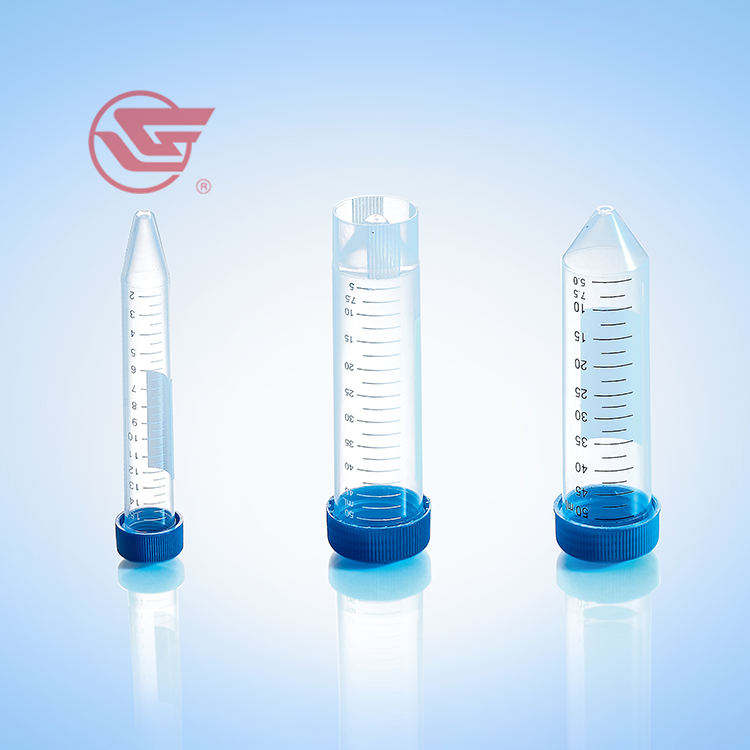
For example, Gongdong's 15ml and 50ml centrifuge tubes are made from polypropylene and supplied sterile with printed graduations.
Specification | 15ml Tube | 50ml Tube |
|---|---|---|
Material | PP | PP |
Bottom | Conical | Conical / Self-standing |
Maximum Centrifugal Force | Up to 9,000G | Up to 7,000G |
Sterility | Sterile | Sterile |
Material quality affects mechanical strength, chemical resistance, transparency, and sample handling.
When evaluating a PP centrifuge tube, check the following points:
Wall consistency: Uniform molding helps distribute centrifugal stress.
Transparency: Clear walls make it easier to observe liquid levels and pellets.
Graduations: Markings should remain easy to read during routine use.
Tube dimensions: Consistent dimensions improve compatibility with centrifuges, racks, and adapters.
For sensitive molecular or clinical applications, also confirm the required cleanliness, sterility, and contamination-control specifications.
The closure system helps protect samples during centrifugation, transport, storage, and routine handling.
Important points include:
Smooth thread engagement
Secure closure without cross-threading
Leak resistance during centrifugation
Cap compatibility with required temperatures
Ease of opening and closing during routine work
Do not evaluate the tube body alone. Tube and cap materials may have different thermal and mechanical limits.
Feature | What to Check |
|---|---|
Thread Design | Smooth closure without misalignment |
Seal | No visible leakage during normal use |
Repeated Use During Processing | Threads should remain stable after repeated opening and closing |
Temperature | Confirm the complete tube-and-cap temperature specification |
Not every centrifuge tube needs the same performance characteristics.
Selection depends on the application:
Application | Important Requirements |
|---|---|
Routine Sample Separation | RCF, tube volume, graduations, cap sealing |
Molecular Biology | Cleanliness requirements, sample recovery, contamination control |
Clinical Chemistry | Consistent quality, sterility, compatibility with laboratory workflows |
Low-Temperature Storage | Published temperature range and closure performance |
Specialized workflows may also require RNase/DNase-free, low-binding, pyrogen-free, or other application-specific specifications. These claims should be confirmed through the supplier's documentation.
Technical specifications are only one part of procurement. Consistent manufacturing and supply are also important for laboratory operations.
Before placing a bulk order, review:
Product documentation: Confirm material, RCF, dimensions, temperature limits, and sterility.
Sample testing: Test representative tubes with your actual centrifuge and rotor configuration.
Batch consistency: Review applicable quality-control and lot documentation.
Packaging: Compare bulk, bagged, or racked configurations according to laboratory workflow.
Supply capability: Review production capacity, lead time, and product availability.
Gongdong's centrifuge and cryo tube range includes multiple centrifuge tube sizes, micro centrifuge tubes, cryo vials, and related laboratory products.
Evaluating centrifuge tube performance requires more than comparing capacity and price. RCF, material, tube geometry, sealing, temperature limits, and application requirements should all be considered.
For bulk procurement, verify the product specification and test representative samples under your laboratory's actual operating conditions.
For centrifuge tube specifications, samples, packaging options, or laboratory consumable sourcing requirements, contact Zhejiang Gongdong® Medical Technology Co., Ltd.
A: RCF reflects the actual centrifugal force applied to the tube, while RPM only describes rotor speed.
A: Not necessarily. Gongdong's current 15ml tube is rated up to 9,000G, while its 50ml tube is rated up to 7,000G. Always check the exact product specification.
A: No. Tube design, resin, cap material, and manufacturing specifications may differ. Follow the published temperature range for the exact product.
A: Check RCF, material, size, tube design, cap sealing, temperature range, sterility requirements, packaging, and supplier documentation.
A: Yes. Representative samples can help confirm compatibility with your centrifuge, rotor, temperature conditions, and laboratory workflow.