

Views: 0 Author: Site Editor Publish Time: 2026-08-24 Origin: Site


Selecting the wrong cell culture flask can reduce cell viability, distort experimental data, and waste expensive media. Surface chemistry is especially important because it directly affects cell attachment and growth.
Flasks that appear similar may use different surface treatments, cap designs, geometries, and manufacturing controls. These differences can influence reproducibility across multiple culture cycles.
This guide explains how to select the correct cell culture flask based on cell type, surface treatment, flask size, cap configuration, sterility, and supplier quality.
TC treated flasks use plasma surface modification to create a hydrophilic surface suitable for adherent cell culture.
A non treated culture flask retains the natural hydrophobicity of polystyrene and is generally used for suspension cell culture.
Selecting a sterile cell culture flask also requires evaluating flask size, neck geometry, and vented or plug-seal caps.
Procurement teams should verify optical clarity, endotoxin control, sterility documentation, and lot-to-lot consistency.
Surface chemistry determines how cells interact with the flask. Selecting the wrong treatment can reduce attachment, alter cell morphology, or cause unexpected cell loss.
Incorrect surface selection may force laboratories to discard samples, repeat experiments, and adjust established protocols. Standardizing flask specifications helps improve workflow consistency.
Understanding the difference between treated and untreated polystyrene also makes it easier to match each flask to the correct cell line.
Manufacturers design a TC treated flask for anchorage-dependent cells. Untreated polystyrene is naturally hydrophobic and does not provide an ideal surface for cell attachment.
Mechanism: Plasma treatment introduces polar functional groups onto the polystyrene surface. This modification increases wettability and improves interaction with proteins in the culture medium.
Outcome: Proteins can adsorb more evenly across the surface, allowing cellular integrins to bind. Cells can then attach, spread, and form a stable monolayer.
Suspension cells do not require a surface designed for attachment. These applications typically use unmodified polystyrene.
Mechanism: A non treated culture flask is produced without the secondary plasma-treatment process.
Outcome: The surface remains hydrophobic, reducing protein adsorption and cell attachment. Cells remain suspended as individual cells, aggregates, or spheroids, depending on the culture model.
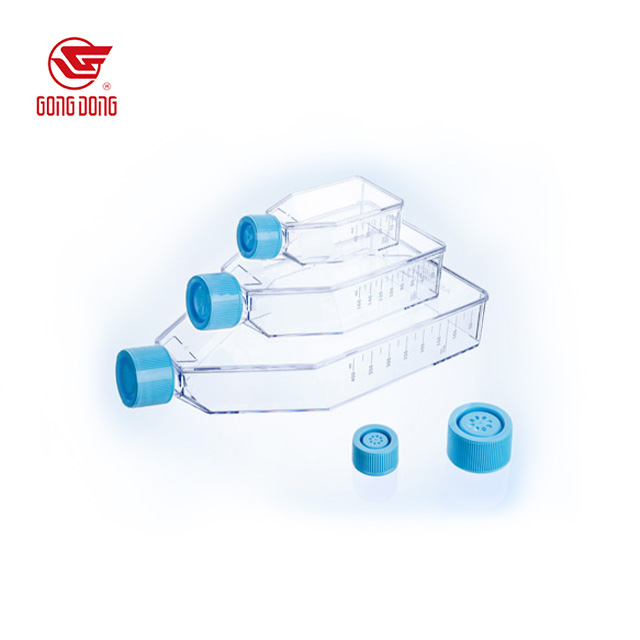
Anchorage-dependent cells require a consistent hydrophilic surface. Reliable adherent cell culture depends on uniform treatment across the entire growth area.
Healthy adherent cultures should attach within the expected period and form a relatively uniform monolayer. Patchy growth may indicate unsuitable surface treatment, uneven seeding, or poor handling.
Cells should also detach predictably during passaging. Trypsin-EDTA or another approved dissociation reagent should release the monolayer without excessive damage.
Treated flasks are commonly used for primary cells and established adherent lines such as HeLa, HEK-293, and CHO cells.
Stem cells and weakly adherent cultures may require additional coatings, including collagen or Poly-D-Lysine, depending on the protocol.
Treatment quality should be assessed through actual culture performance rather than appearance alone.
Treatment Uniformity: Uneven treatment can create low-attachment areas and inconsistent cell density across the flask surface.
Coating Compatibility: The treated surface should support any secondary biological coating required by the selected cell line.
Best Practices: Examine newly seeded cultures under a phase-contrast microscope. Check the center, edges, and corners for uneven attachment or cell clumping.
Suspension cultures require an inert environment that limits unintended attachment while supporting adequate gas exchange and mixing.
Cells should remain suspended throughout the culture period with acceptable viability and minimal unwanted adhesion.
Excessive clumping, sedimentation, or attachment may indicate unsuitable surface characteristics, insufficient agitation, or a change in cell behavior.
Suspension formats are widely used for lymphocytes, hybridomas, embryoid bodies, and selected recombinant protein production systems.
The correct flask design depends on cell density, agitation method, media volume, gas-exchange requirements, and culture duration.
Suspension cultures may expose the flask to continuous movement. Both material purity and structural stability should be evaluated.
Surface Inertness: The material should remain stable and should not release substances that interfere with cell growth or differentiation.
Agitation Tolerance: Flasks used in shaking incubators should withstand repeated orbital movement without seam damage or cracking.
Common Mistakes: Do not assume every untreated flask is suitable for continuous agitation. Verify the manufacturer's recommended operating conditions before use.
Surface treatment determines biological compatibility, while flask geometry determines working volume, growth area, and incubator efficiency.
Select the internal surface area according to the required cell yield, seeding density, media volume, and available incubator space.
Cell Culture Scaling and Geometry Chart | |||
Flask Format | Surface Area | Typical Workflow Application | Average Cell Yield (Example) |
|---|---|---|---|
T-25 | 25 cm² | Routine passaging, initial seed revival, small-scale assays. | 2.5 x 10⁶ cells |
T-75 | 75 cm² | Standard expansion, routine laboratory maintenance. | 7.5 x 10⁶ cells |
T-175 | 175 cm² | High-yield production, downstream bioprocessing prep. | 1.75 x 10⁷ cells |
T-225 | 225 cm² | Massive scale out, maximizing incubator shelf space. | 2.25 x 10⁷ cells |
Canted necks improve pipette and scraper access to the flask corners. Straight necks may reduce sloshing during transport but can restrict access to the rear surface.
Cap design controls gas exchange and helps maintain the internal culture environment.
Vented Caps: These use an integrated 0.22 µm hydrophobic membrane to support gas exchange while maintaining a microbial barrier. They are commonly used in CO2 incubators.
Plug Seal Caps: These create a closed barrier and are suitable for transport or protocols that do not require continuous external gas exchange.
Surface selection, incubator conditions, manufacturing consistency, and contamination control can all affect culture performance.
Suspension cells may attach when placed in a treated flask. Removing them with scraping or strong dissociation reagents can reduce viability and disrupt downstream assays.
Check the surface-treatment label before seeding and separate treated and untreated inventory clearly.
Low incubator humidity or unsuitable cap conditions can increase media evaporation. This may alter osmolarity and reduce cell viability, particularly around the flask edges.
Monitor incubator humidity, media volume, cap position, and culture duration to reduce evaporation-related effects.
Inconsistent plasma treatment or molding conditions may create different attachment performance between production lots.
Mitigation: Request Certificates of Analysis and evaluate representative samples from multiple lots. Compare attachment, morphology, confluence, and cell yield under the same culture conditions.
Newly opened laboratory plastics should not be assumed to meet every sterility or purity requirement without supporting documentation.
Mitigation: Source a documented sterile cell culture flask. Verify the sterilization method, Sterility Assurance Level, lot traceability, endotoxin limits, and applicable RNase-free or DNase-free claims.
A structured qualification process helps laboratories reduce performance differences between brands and production lots.
Step 1: Audit Current Workflows. Record active adherent and suspension cell lines, flask sizes, weekly consumption, cap requirements, and incubator conditions.
Step 2: Request Evaluation Samples. Test representative flasks using a sensitive or frequently used cell line. Monitor attachment, morphology, viability, and growth over a complete culture cycle.
Step 3: Verify Certifications. Review lot-traceable sterility, non-pyrogenicity, material, and biological-safety documentation. Confirm whether any claimed USP Class VI compliance applies to the product.
Step 4: Consolidate Suppliers. Standardizing around a qualified supplier can reduce variation in surface treatment, flask geometry, cap performance, and optical quality.
Document all evaluation results before updating laboratory SOPs or committing to a large-volume purchase.
The choice between treated and non-treated flasks should be based on cell behavior. Hydrophilic treated surfaces support anchorage-dependent cells, while untreated hydrophobic surfaces are generally more suitable for suspension cultures.
Flask size, neck geometry, cap design, optical clarity, sterility, and batch consistency should also match the laboratory's workflow and incubator conditions.
Before bulk purchasing, request product samples and quality documentation. Evaluate the flasks with actual cell lines and record attachment, viability, morphology, and growth performance.
For cell culture flask samples, surface-treatment options, packaging, quality documentation, bulk procurement, or customized laboratory consumable requirements, contact Gongdong Zhejiang Gongdong® Medical Technology Co., Ltd. to share your application and sourcing specifications.
A: It may be possible with coatings such as Poly-L-Lysine, but attachment can be less consistent than with a TC treated flask.
The coating method, cell type, incubation time, and surface compatibility should be validated before routine use.
A: When stored correctly, the treatment may remain stable for several years. Always follow the manufacturer's stated expiration date and storage conditions.
Keep unopened flasks sealed and protect them from excessive heat, humidity, and direct ultraviolet exposure.
A: These terms are commonly used to describe a surface modification that improves cell attachment to polystyrene.
The exact treatment method and performance specification should still be verified with the manufacturer.
A: The flask may have a treated surface, or the cell line may develop weak adherence under certain culture conditions.
Confirm the flask specification and consider a non-treated or ultra-low attachment format when the protocol requires minimal adhesion.


