
Views: 0 Author: Site Editor Publish Time: 2026-02-09 Origin: Site
Cell culture is essential for biological and medical research, supporting experiments in cell growth and drug development. A crucial factor in the success of these experiments is selecting the right cell culture flasks. The correct flask size ensures optimal growth and reduces contamination risks. In this article, we will explore how choosing the right cell culture flask size can impact your research. You will learn about the effects on cell density, nutrient exchange, and experiment outcomes.
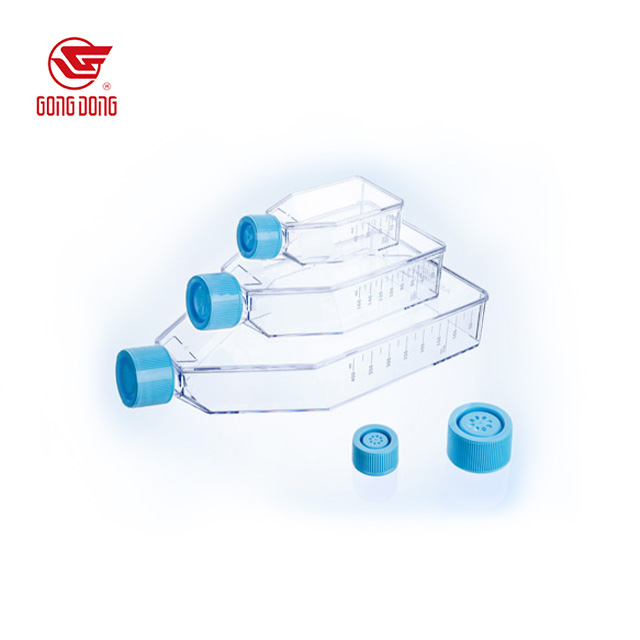
Cell culture flasks are containers used to grow and maintain cells outside their natural environment, typically in a controlled laboratory setting. They are designed to provide a sterile and supportive environment for cells, ensuring proper nutrient supply, gas exchange, and waste removal.
These flasks come in various shapes and sizes, depending on the type of cells being cultured and the scale of the experiment. The most common materials used to make cell culture flasks are polystyrene (for disposable flasks) and glass (often used for more long-term or specialized uses).
There are several types of cell culture flasks, each designed for specific applications:
Flask Type | Description | Typical Uses |
T-flasks | Flat, rectangular-shaped flasks commonly used for adherent cells. | Small to medium-scale experiments for adherent cells. |
Erlenmeyer flasks | Conical shape with a wider neck, ideal for mixing and suspension cultures. | Suspension cell cultures, larger volumes. |
Roller bottles | Cylindrical flasks that rotate to provide a more dynamic environment for cells. | Large-scale culture of adherent cells. |
Specialized flasks | Includes multiwell plates, spinner flasks, and other custom designs. | High-throughput applications, bioreactor setups. |
Flask size plays a significant role in the overall health of cultured cells. A flask that is too small might not provide enough surface area or media volume to support healthy growth, while a flask that is too large may waste resources and make it more difficult to maintain the right cell density.
● Larger flasks allow for more cells to be cultured, providing more surface area for cell attachment (in the case of adherent cells) and greater media volume for nutrient supply.
● Smaller flasks, on the other hand, are better suited for small-scale experiments and allow for more controlled conditions with less risk of contamination.
Additionally, the surface area-to-volume ratio in larger flasks improves oxygenation and nutrient exchange, which is essential for maintaining cell health. Smaller flasks, in contrast, may experience more rapid depletion of nutrients, requiring more frequent media changes.
Selecting the appropriate flask size depends on multiple factors, such as the type of cells, the media volume, the growth characteristics of the cells, and the scale of the experiment.
Flask Size | Best For | Cell Type Example |
Small (25 cm² to 75 cm²) | Small-scale experiments, low-density cultures. | HEK293 cells, some primary cells. |
Medium (75 cm² to 150 cm²) | Standard culture needs, moderate-density growth. | NIH3T3 cells, fibroblasts. |
Large (150 cm² and above) | High-density cultures, larger volumes. | CHO cells, large-scale protein production. |
Small flasks are typically used for small-scale cell culture and research that involves low cell density or a limited number of cells. They are ideal for early-phase research or when experimenting with new cell lines.
● Applications: Small-scale experiments, basic cell line maintenance, and assays that require low cell numbers.
Medium-sized flasks strike a balance between space and media volume. They are versatile and often used for more generalized research where cell growth is required in moderate amounts.
● Applications: Standard culture of adherent cells, maintenance of cell lines, and small-scale production of proteins or other biomolecules.
Large flasks are used in high-density cell cultures, where a large number of cells need to be grown simultaneously. They are suitable for scaling up research and industrial applications where cell growth is vital for experiments such as drug testing or protein production.
● Applications: Bioreactor-like environments, commercial-scale cultures, and experiments requiring large quantities of cells.
The design of the flask plays an essential role in determining how cells interact with the flask surface.
● Flat flasks (like T-flasks) provide a larger surface area for cell attachment, making them suitable for adherent cells.
● Conical flasks (like Erlenmeyer flasks) have a smaller surface area but offer greater mixing potential, making them ideal for suspension cultures.
The shape influences not only cell growth but also the ease of handling and media exchange. Flat flasks are often used for experiments involving fixed cell monolayers, while conical flasks are best for cells that grow in suspension.
Vented flasks feature a breathable membrane that allows gas exchange while preventing contamination. These flasks are particularly important when cell culture requires high levels of oxygenation or when media evaporation could be an issue.
Flask Type | Benefits | Limitations |
Vented flasks | Facilitates oxygen exchange, controls media evaporation, reduces contamination risk. | Higher cost, requires careful handling. |
Non-vented flasks | Prevents contamination by sealing the flask. | Limited gas exchange, requires precise environment control. |
The correct media volume is vital to maintaining the health of cells. Overfilling or underfilling a flask can have detrimental effects on cell viability and experimental outcomes.
● Overfilling may lead to difficulties with gas exchange, while underfilling could cause insufficient nutrient supply, leading to poor cell growth.
Each flask size is designed to handle specific media volumes. Ensure that your flask is matched to the correct volume for optimal performance.
The size of the flask not only affects the quality of your cell culture but also your budget. Larger flasks require more media, more space in your incubator, and more frequent monitoring, all of which can add to costs.
● Small flasks are generally more resource-efficient for smaller experiments, but scaling up may require the use of larger flasks for increased cell yields.
Balancing the scale of your experiments with flask size will help keep costs manageable while ensuring high-quality cell culture.
Choosing the right flask size can have a direct impact on the yield and quality of your cell cultures. Larger flasks provide more surface area for cells to grow and more volume for nutrients, which often results in higher cell yield.
Flask Size | Expected Yield (per 100 mL of media) | Quality of Cells (based on flask design) |
Small (25 cm² to 75 cm²) | Low yield, suitable for early-stage cultures. | Moderate, good for controlled environments. |
Medium (75 cm² to 150 cm²) | Balanced yield for routine research. | High quality, suitable for standardized cell lines. |
Large (150 cm² and above) | High yield, suitable for scaling up experiments. | Excellent, ideal for large-scale applications. |
With different flask sizes, some challenges arise. For example, larger flasks can face issues with cell detachment, while smaller flasks may suffer from nutrient depletion more quickly.
● Solutions: Proper media replenishment, using the right surface coatings, and monitoring environmental conditions (e.g., CO2 levels) can help mitigate common problems.
Selecting the correct cell culture flask size is crucial for the success of any experiment. Whether you're working on small-scale research or large-scale production, understanding the differences between flask sizes ensures that you provide the optimal environment for your cells. Always match the flask size to the specific requirements of your experiment, keeping in mind cell type, growth characteristics, and resource efficiency.
As cell culture technologies continue to advance, further exploration of flask specifications will help you optimize research and ensure more reproducible results in your studies. Zhejiang Gongdong® Medical Technology Co., Ltd. is committed to supporting these advancements. Gongdong’s cell culture flasks provide ideal environments for cell growth, featuring treated surfaces that promote uniform cell adhesion. Produced in sterile cleanrooms, our flasks deliver consistent sterility and leak-proof sealing, essential for successful cell culture work. The advanced mold design ensures precise shape and clarity, making them ideal for microscopic examination. Available in various volumes, Gongdong’s flasks are trusted tools for scientists engaged in drug development, regenerative medicine, and bioproduction, delivering consistent and reliable performance across diverse laboratory applications.
A: Cell culture flasks are containers used to grow and maintain cells in a laboratory setting. They are designed to provide a sterile environment that supports cell growth by ensuring proper nutrient supply, oxygenation, and waste removal. The right flask size is critical for optimizing cell viability and experiment outcomes.
A: The choice of flask size depends on factors like cell type, growth characteristics, and experiment scale. Smaller flasks (25 cm² to 75 cm²) are ideal for small-scale experiments, while larger flasks (150 cm² and above) support high-density cell cultures or large-scale applications like protein production.
A: Flask size impacts nutrient exchange, cell density, and overall growth. Larger flasks provide more surface area and media volume, leading to better oxygenation and nutrient distribution. Smaller flasks offer more controlled conditions but may require more frequent media changes.
A: Larger cell culture flasks tend to be more expensive due to increased material costs and higher media volume requirements. Smaller flasks are more cost-effective for small-scale research but may not provide sufficient capacity for large-scale cell culture.
A: Common issues include contamination, cell detachment in larger flasks, and nutrient depletion in smaller flasks. Choosing the right size and ensuring proper media replenishment can help mitigate these problems and improve experiment success.


